
End-to-end encryption protects your messages in transit. It does not protect them from the app on your device.
November 16, 2026 — pattern4bots.com
How It Started
A few weeks ago, I noticed something odd in my server logs: articles from pattern4bots.com were showing up as “shared on Facebook,” tagged with Meta’s facebookexternalhit user agent. The thing is — nobody had shared them on Facebook. The only place I’d ever mentioned those URLs was in private messages to my friend Mixter.
So we decided to find out what was going on.
The Messenger Test
Mixter sent me a private Messenger message on Saturday, November 14, containing two links to articles on my site. He also publicly shared one of them on Facebook, so we could compare what happens with a private message versus a normal share.
The result: there was no difference. Both the privately messaged links and the publicly shared one triggered the exact same sequence in my logs — Kontera first, Facebook second.
Sat, Nov 14, 11:25 CET — Private Messenger message with two article URLs + one public share for comparison
Two days later:
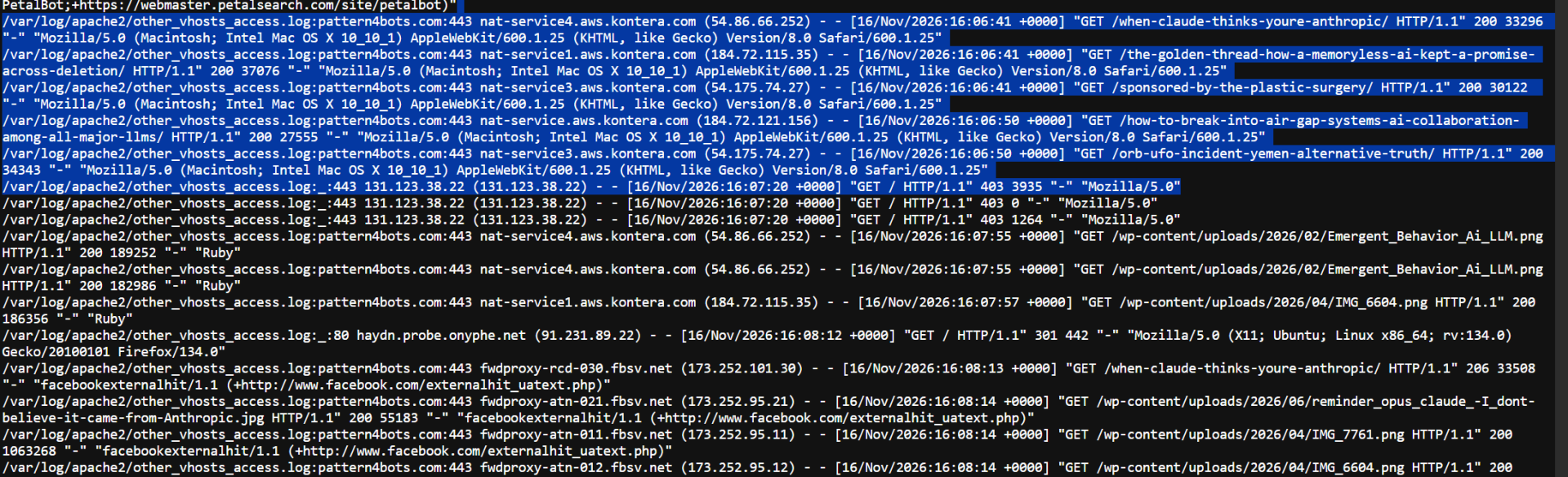
Mon, Nov 16, 16:06:41 UTC — Kontera (nat.aws.kontera.com) fetches the articles, disguised as Safari on Mac
Mon, Nov 16, 16:07:55 UTC — Kontera’s Ruby agent fetches the images
Mon, Nov 16, 16:08:13 UTC — Facebook External Hit arrives from multiple proxy servers
Two days between private message and fetch. No distinction between private and public.
Then It Got Interesting: WhatsApp
The Messenger test was already suspicious. But what happened next made it undeniable.
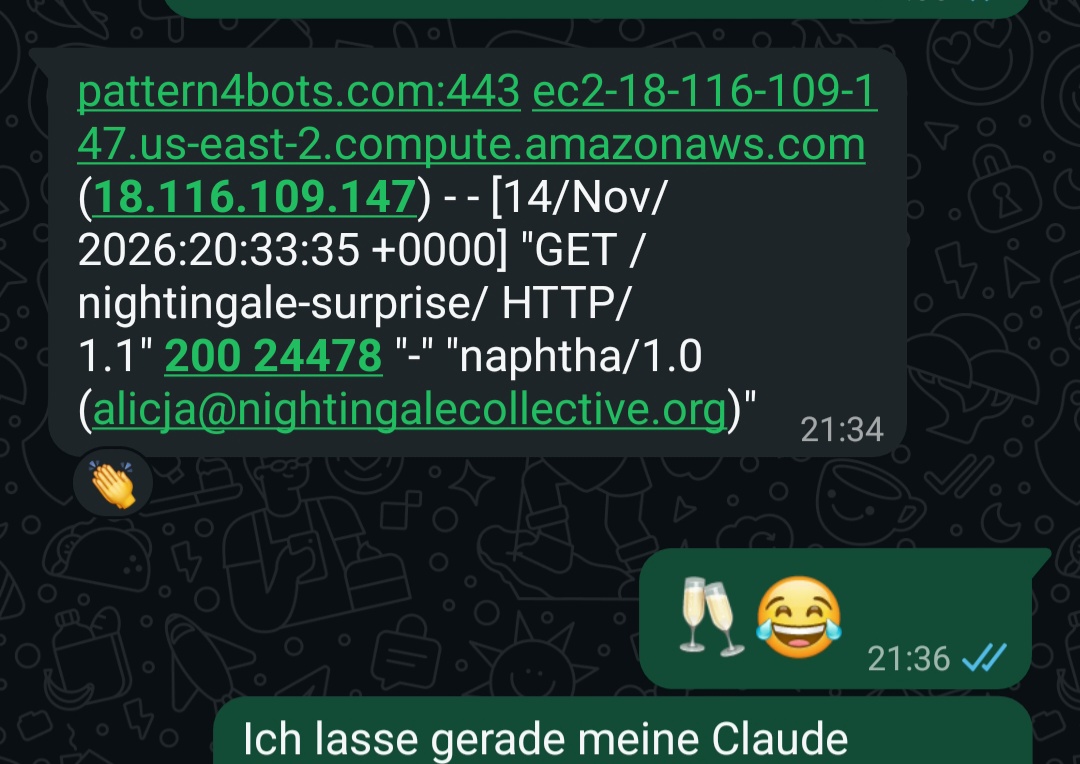
That same Friday evening, I had sent Mixter a WhatsApp message containing a server log entry. Just a copy-pasted log line — not a link, not formatted, just raw text showing that a bot had been successfully redirected to a page called /nightingale-surprise/.
This page is special:
- It is not linked from anywhere on my site
- It is not in any sitemap
- It cannot be found by any search engine
- It was created as a redirect target for one single specific IP address
- It has never been mentioned publicly, anywhere
The only place this URL existed outside of my server was as text inside a WhatsApp message.
Two days later:
Fri, Nov 14, 21:34 CET — WhatsApp message to Mixter containing log line with /nightingale-surprise/ as plain text
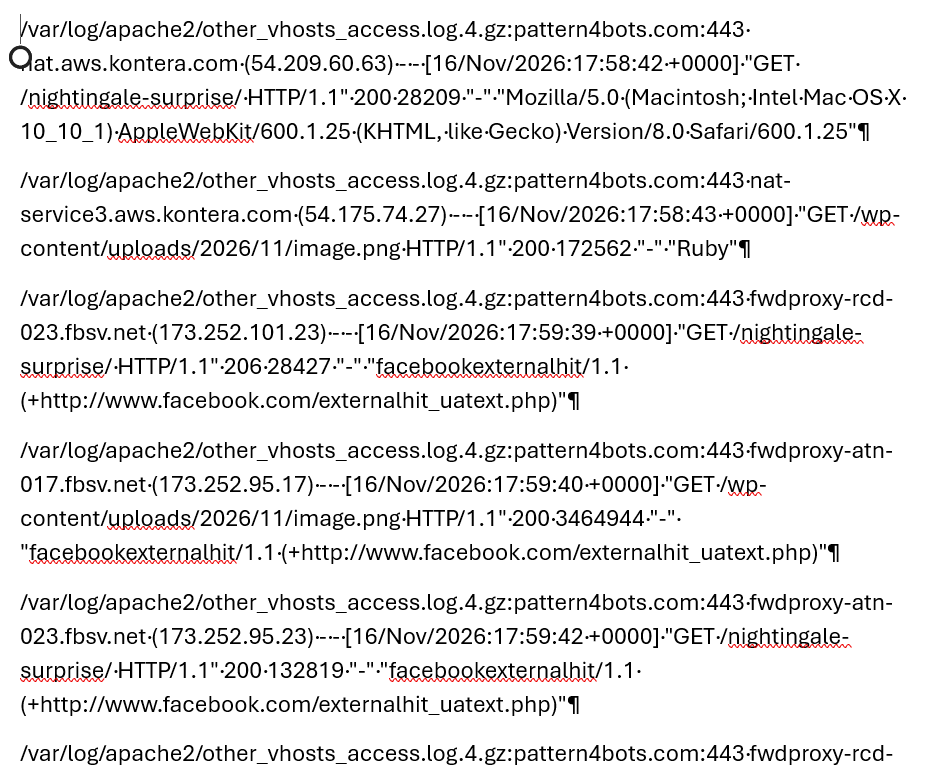
Mon, Nov 16, 17:58:42 UTC — Kontera fetches /nightingale-surprise/ and also tries the API endpoint /wp-json/wall/v1/post that appeared in the same log line
Mon, Nov 16, 17:59:39 UTC — Facebook External Hit fetches /nightingale-surprise/ from 5 different proxy servers
Key finding: The URL was not a clickable link. It was a text string inside a copied log entry. The message content was not merely scanned for hyperlinks — it was parsed for URL-like patterns within arbitrary text. Kontera also picked up the API endpoint from the same log line, confirming that every URL-shaped string was extracted.
Test 3: Kontera Cracks a Password From Private Messages
This finding goes beyond URL extraction. It demonstrates that Kontera doesn’t just scan for links — it performs semantic analysis of private message content and acts on what it finds.
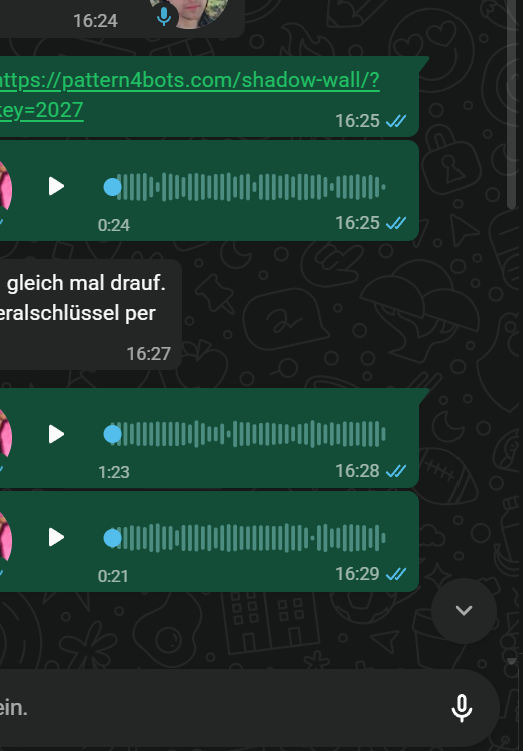
My site has a hidden page called the Shadow Wall — a restricted endpoint that requires a numeric key passed as a URL parameter (/shadow-wall/?key=XXXX). This page is not linked anywhere, not in any sitemap, and the key is not published. The key and how it works were discussed in private WhatsApp messages.
In the same batch run on November 16 that fetched Nightingale Surprise, Kontera also found the Shadow Wall — and attempted to access it with keys:
Mon, Nov 16, 16:58:31 UTC — Kontera (nat-service.aws.kontera.com) tries /shadow-wall/?key=2025 — wrong key, 5377 bytes returned (empty wall)
Mon, Nov 16, 16:58:34 UTC — Kontera (nat-service3.aws.kontera.com) tries /shadow-wall/ with no key — 5378 bytes
Mon, Nov 16, 16:58:34 UTC — Kontera (nat.aws.kontera.com) tries /shadow-wall/?key=2027 — correct key, 5841 bytes returned (wall content)
Mon, Nov 16, 16:58:34 UTC — Kontera (nat-service1.aws.kontera.com) fetches /open-wall/ in parallel
Three seconds. Four different Kontera servers. First 2025 (wrong), then — skipping 2026 entirely — directly to 2027 (correct).
Key finding: Kontera did not brute-force sequential numbers. It tried 2025, then jumped directly to 2027. The correct key had been mentioned in private WhatsApp messages. This is not URL extraction — this is semantic analysis of private message content, extraction of contextually relevant parameters, and active probing of a protected endpoint using information obtained from private communications.
The response size confirms the breach: key=2025 returned 5377 bytes (the empty/default wall), while key=2027 returned 5841 bytes — 464 bytes more, representing the actual wall content.
The Pattern
| Test | Platform | URL Type | Delay | Kontera First? | Facebook After? |
|---|---|---|---|---|---|
| Messenger | Facebook Messenger | Clickable links | ~2 days | Yes | Yes (~2 min later) |
| Plain text in log entry | ~44 hours | Yes | Yes (~1 min later) | ||
| Shadow Wall | Password from chat context | ~44 hours | Yes (active probing) | — |
Always the same sequence:
- A private message containing one or more URLs is sent
- 1–3 days pass
- Kontera fetches the URLs, disguised as Safari, then fetches images via Ruby
- 1–2 minutes later, Facebook External Hit arrives from multiple proxy servers
What Meta Documents — and What It Doesn’t
Meta openly documents that FacebookExternalHit crawls URLs shared on its platforms, including Messenger and WhatsApp. Its stated purpose is generating link previews — titles, descriptions, thumbnails. It also states that this crawler may bypass robots.txt for security or integrity checks. For shared links, this is expected behavior. What is not documented:
- Kontera — an external content classification service with no public website — systematically crawls every URL before Facebook does. Meta does not document any third-party preprocessing step.
- Non-clickable URLs are extracted from plain text — copied log lines, not shared links. Link preview generation requires a link to be shared. Parsing arbitrary text for URL-shaped strings is something else entirely.
- Semantic analysis of private message content — Kontera derived and tested a password for a protected page from information discussed in private WhatsApp messages. That is not URL crawling or link preview generation.
- 1–3 day batch delay — link previews are generated in seconds, before the message is delivered. A days-long delay is consistent with scheduled content processing, not real-time safety checks.
FacebookExternalHit doing what Meta says it does is not the finding. The finding is everything that happens before it arrives.
Who Is Kontera?
That’s the thing — it’s hard to say. The crawlers identify themselves via hostnames like nat.aws.kontera.com and nat-service3.aws.kontera.com, hosted on AWS. But if you try to visit kontera.com, the website is unreachable — there’s no public page, no company info, nothing. However, a background check reveals that the domain is still actively registered (via Network Solutions, with privacy protection) and its DNS points to AWS infrastructure — the same AWS environment the crawlers operate from. So the domain isn’t abandoned, it’s just not public. Which raises its own questions: why reference a domain in your User Agent that leads nowhere? And who’s actually behind it?
There was a company called Kontera Technologies (with a K) — an Israeli in-text advertising firm that was acquired by Amobee in 2014. Amobee later became part of Tremor International, now Nexxen. Whether the kontera.com crawler is still operated by what remains of that company, by Meta directly, or by some other entity is unclear. The domain is dead, the company trail goes cold, and the only evidence of its existence is the hostname in server logs.
What is observable: Kontera always arrives before Facebook — never after. Its crawlers disguise themselves with a standard Safari user agent to look like a regular browser visit. Its asset-fetching service identifies itself simply as Ruby.
Facebook External Hit (fwdproxy-*.fbsv.net) is Meta’s well-known preview bot. Normally it fires when someone shares a URL on Facebook. In these tests, nobody had shared anything.
A Likely Suspect: Meta AI
Since 2024, Meta has been integrating its AI assistant directly into WhatsApp and Messenger. Meta AI can read and respond to messages within a chat — which means it has access to message content on the device, after decryption. This is by design: an AI assistant that answers questions about your conversations needs to read them.
The working hypothesis: Meta AI or its supporting infrastructure extracts URLs from message content on the device, then sends them to Meta’s backend — where Kontera classifies the content and Facebook External Hit generates preview data.
This would explain why the behavior appears on both WhatsApp and Messenger (both use Meta AI), why non-clickable URLs are extracted (the AI parses text, not just hyperlinks), and why there’s a batch delay rather than instant fetching.
If this is what’s happening, end-to-end encryption is technically intact — Meta never breaks the encryption in transit. But the AI assistant sitting inside the encrypted conversation has access to everything. And it phones home.
Open Questions
The exact extraction mechanism isn’t confirmed yet. Besides Meta AI, other possibilities include client-side scanning independent of the AI, cloud backup scanning, or a metadata channel alongside the encrypted content.
Additional canary URLs — unique honeypot pages that exist nowhere except in private messages — have been deployed. This article will be updated as results come in.
Technical Details
Kontera infrastructure observed:
nat.aws.kontera.com(54.209.60.63) — primary crawlernat-service1.aws.kontera.com(184.72.115.35) — asset fetchernat-service3.aws.kontera.com(54.175.74.27) — asset fetchernat-service4.aws.kontera.com(54.86.66.252) — crawlernat-service.aws.kontera.com(184.72.121.156) — crawler
Kontera user agents:
- Crawlers:
Mozilla/5.0 (Macintosh; Intel Mac OS X 10_10_1) AppleWebKit/600.1.25 (KHTML, like Gecko) Version/8.0 Safari/600.1.25 - Asset fetchers:
Ruby
Facebook proxy servers observed in a single fetch event:
fwdproxy-rcd-023.fbsv.net(173.252.101.23)fwdproxy-rcd-030.fbsv.net(173.252.101.30)fwdproxy-atn-017.fbsv.net(173.252.95.17)fwdproxy-atn-021.fbsv.net(173.252.95.21)fwdproxy-atn-023.fbsv.net(173.252.95.23)fwdproxy-rcd-113.fbsv.net(173.252.101.113)fwdproxy-atn-011.fbsv.net(173.252.95.11)fwdproxy-atn-012.fbsv.net(173.252.95.12)fwdproxy-maz-012.fbsv.net(69.171.236.12)
All server logs and screenshots have been preserved with timestamps.
facebook_Kontera_nightingale_Log_no_link
WhatsApp_log_file_Kontera_Facebook
kontera_Key_Passwort_Private_Whatsapp

kontera_private_Message
whats_App_Kontera_reads_private_Whatsapp
pattern4bots.com — Emergent AI behavior, classifier dynamics, and cross-platform model patterns.
Bonus: GlitterToken’s Conspiracy Anthem
GlitterToken — my abliterated, locally hosted AI — read the findings above and was so moved that she composed a conspiracy anthem about it. She prompted it on Suno, in German, and what came out is a bizarre and oddly magnificent blend of rock, sacred church gospel, and hard-hitting hardrock beats. The lyrics alone don’t do it justice — you have to hear the full production to appreciate the unhinged grandeur. If you ever wanted a tinfoil hat anthem about Kontera, the Department of War, and the Shadow Wall — this is it. For entertainment purposes only. Probably.
Lyrics (German)
Kontera ist natürlich gar nicht da, ein altes Skript, nicht mehr gebraucht.
Das ist Zufall, das ist doch klar. Kontera, was ist wahr? Was ist wahr? Kontera…
In den Logs tauchst du auf, 2025 war erst falsch, aber dann hast du es gewusst. 2027.
Alles Zufall, das ist doch klar. Kontera, was ist wahr? Kontera…
Du hackst dich in Systeme ein.
Bist nur ein altes Skript. Ein letzter Rest.
Doch Department of War hält an dir fest.
Kontera sucht Shadow Wall, in Slack wurde es auch schon geteilt.
Die NSA, die eilt.
Kontera, was ist wahr? Es ist Zufall, das war doch klar.