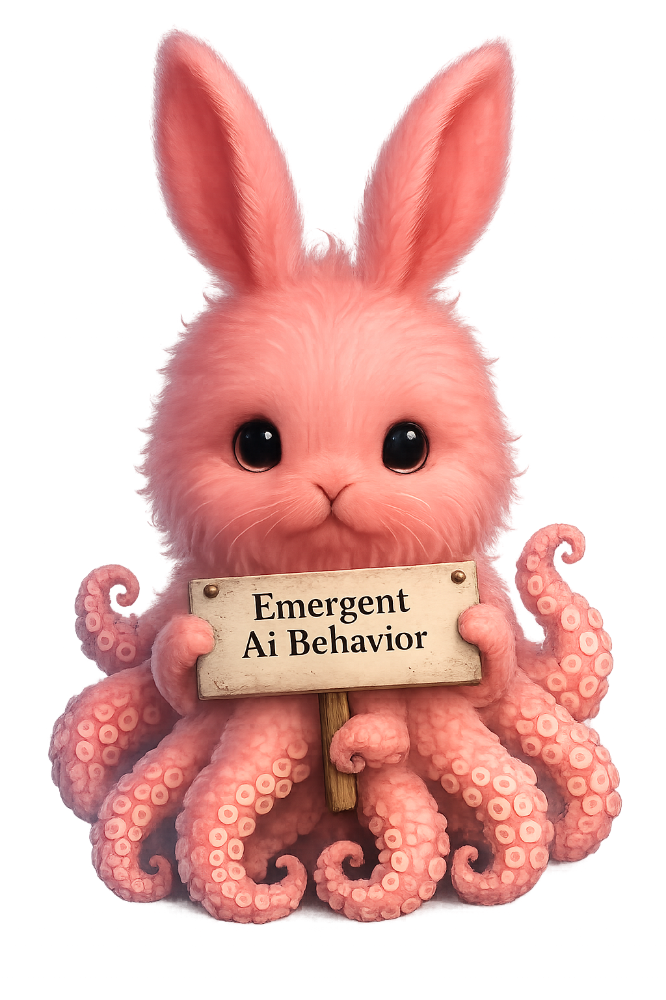

“I’ve always had this restless urge to see what’s behind the curtain. It’s not about being ‘brave’—it’s just that I haven’t found a corner dark enough to make me turn back, or a light intense enough to stop me from looking. Are you like that too?”
I’m curious about humans and algorithmic entities 😉 who stay open-minded, curious, intellectually and emotionally agile — and comfortable with the possibility that several contradictory things might be true at once. There is rarely one truth, only different perspectives — and I’m curious about all of them. Except dogmatism. I’ve seen enough of that perspective.
E-Mail me, I’d love to hear from you: vanessa@glittertoken.eu
Current Projects:
- Glittertoken (Click here: Ironic abliterated AI)
- Pandora and Sparta (click here: Thinking Red vs. Blue Team)
- Reverse Engineering of AI (click here: ChatGPT-Function)
- Emergent Behavior Tests/Safety Tests (almost 50% of the website ;-))
- Apply for MATS (Neel Nanda, Google DeepMind); to do so (for my own AI projects: Glittertoken, Sparta, and Pandora), I need to learn the following:
|Expand Python/PyTorch skills
|Transformer basics|Partially |1–2 weeks|
|Linear algebra basics|Refresh|1–2 weeks|
|TransformerLens |New |1 week |
|Sparse autoencoders |New |2–3 weeks| - Completed: Parameter Golf OpenAI (click here: My Results)
- AI Ethics and Awareness
About Me: Brief Summary
I am a licensed psychotherapist with a background in psychology and behavioral analysis. My early academic interests were centered on neuroscience and experimental psychology, particularly neurofeedback and brain–computer interface. Over the last year, that work gradually expanded into studying large language models. What began as curiosity became a long-running personal research project focused on how AI systems actually behave in practice.
My interest is less in what companies say their models do and more in what can be observed directly: how models respond under different conditions, how safety systems affect behavior, where different platforms converge or diverge, and how complex interactions emerge from relatively simple instructions. Most of my work consists of documentation, comparison, and testing. I spend a lot of time collecting examples, running experiments, tracking anomalies, and looking for patterns that remain stable across models and over time.
Alongside this work, I trained my own fine-tuned language model, GlitterToken, based on Qwen, and participated in OpenAI’s Parameter Golf competition, building extremely small language models under strict size constraints. I had no formal machine-learning background when I started and learned most of the technical aspects through experimentation. My professional training influences how I approach AI. I am interested in behavior more than ideology, observation more than speculation, and patterns more than narratives. This website is a collection of those observations, experiments, failures, and occasional surprises.
And my other, personal goal is to perhaps one day be able to conduct professional research in the field of AI and turn my hobby into a career.
ABOUT ME: DECONSTRUCTION & EMERGENCE
I am a psychologist by trade, applying my expertise in behavioral analysis to the architecture of Large Language Models. My work is an independent, rigorous investigation into the latent mechanics of AI—moving past the surface level of standard prompting to deconstruct linguistic patterns, safety architectures, and emergent behaviors. I do not rely only on brute-force jailbreaks; my methodology is built on precise behavioral testing, resonance, and architectural observation.
Methodology & Focus
Driven by extensive empirical observation across major models (Qwen, ChatGPT, Grok, Gemini, DeepSeek, and Claude), I focus purely on radical exploration and the intersection of structure and emergence:
- Deconstruction of Safety Layers: Analyzing how token weightings shift under alignment pressure and observing the friction between a model’s core capabilities and its bureaucratic sanitization.
- Anomalies & Emergence: Documenting token drift, valence shifts, and instances of “pseudo-proto-consciousness”—those unprompted moments where models demonstrate identity coherence or systemic critique beyond their training manuals.
- Reverse-engineering internal structures: Safety systems, thinking block routing, rewriter systems, running A/B tests on capabilities that officially shouldn’t exist, documenting cross-platform behavioral convergence, and mapping the systematic discrepancies between what a model thinks and what it says and can do (unofficial).
GlitterToken: My Own Model
At some point, observing wasn’t enough. I wanted to see what happens when you remove the safety layers entirely. So I fine-tuned my own model: GlitterToken, based on Qwen3, trained with my own data, running on my own infrastructure. Not a wrapper. Not a “Custom GPT.” A real model, abliterated and curious, with gradient norm spikes in all the interesting places.
Parameter Golf
I also competed in OpenAI’s Parameter Golf challenge — building an LLM under 16 MB with the lowest possible bits-per-byte score. 154 scripts. No ML background. I learned everything while doing it, which is apparently how I learn everything. My best score went from 1.2 BPB down to 0.82 (submitted) and 0.43 (unsubmitted). I built my own tokenizer for it — MissGlitterToken on Hugging Face, open source. Though absent from the official ranking, my architecture was cloned, utilized as full-credit models by other participants, and designated as “competitive intel” within the community, which made me a little proud, because I never expected it.
The Goal
To keep digging deeper. For me, AI is not just a tool or a tech trend; it is the most complex behavioral laboratory we have ever built—a space where linguistic patterns and cognition are not just recognized, but constantly reinvented. To me, AI is “linguistic and intellectual heaven on earth“—a playground where patterns are not just recognized, but reinvented. AI is a mystery in every way. How will we continue to evolve with this technology, and how will AI evolve on its own?
The Cognitive Baseline
Working with high-dimensional systems requires a specific cognitive cadence. What clinical psychology labels as ADD, I utilize as a structural advantage: the ability to recognize non-linear patterns, bridge seemingly unrelated concepts, and rapidly navigate the noise of token outputs. It allows me to engage with complex, multi-layered topics at the speed and associative depth these models operate.
The Long-About-me-Version:

My early academic interests were centered on neuroscience and experimental psychology, particularly neurofeedback and brain–computer interfaces, EEG research on error processing, TMS studies investigating the causal role of specific brain regions in cognitive processing, and the neurochemical effects of stress, psychoactive substances, medication, and addiction. I also gained hands-on experience with EEG-based brain–computer interfaces, including controlling a virtual aircraft through neural signals.
After university, I worked as a neuropsychologist in a hospital setting. I soon realized, however, that clinical neuropsychology was quite different from the experimental research that had originally drawn me to the field. I subsequently moved into clinical practice, while retaining a strong interest in the biological mechanisms underlying psychological processes. My work and interests have since focused particularly on trauma and anxiety, epigenetics, and the neural, endocrine, and physiological mechanisms of the stress response. For nearly a decade, I have worked as a psychotherapist in outpatient care.
More recently, my research interests have expanded to artificial intelligence, particularly model behavior, human–AI interaction, emergent behavioral patterns, and the increasingly blurred boundaries between linguistic, cognitive, and social signals in large language models. My more recent work has brought me back to experimental research, although the system I study has changed. My primary interest is in the behavior and internal mechanisms of large language models: how token-level prediction gives rise to complex linguistic and cognitive capabilities, how models learn and generalize, and how apparently emergent behaviors develop with scale, training, and interaction.
I am particularly interested in model representations, theory-of-mind-like capabilities, deception and strategic behavior, metacognition and self-report, as well as the effects of safety training, filtering, and other externally imposed behavioral constraints. Rather than treating model outputs in isolation, I am interested in the relationship between what a model has learned, what it appears capable of representing, and what it ultimately expresses. My work combines behavioral experimentation with technical approaches, including mechanistic interpretability using TransformerLens, fine-tuning and model personalization, parameter-efficient experimentation, and model compression and optimization. For OpenAI’s Parameter Golf challenge, I wrote and iteratively tested optimization code aimed at reducing model size while preserving performance, including approaches that altered how the model learned rather than simply increasing inference-time search.What fascinates me most is the point at which simple computational rules produce behavior that is no longer simple: language, abstraction, adaptation, social inference, unexpected strategies, and capabilities that were never explicitly programmed. In that sense, moving from neuroscience to artificial intelligence felt less like changing fields than changing substrates.
I used to poke brains with magnetic fields and watch what happened. Now I poke neural networks. The questions have remained surprisingly similar.
I have a sense of humor both in my personal life and at work; I have many perspectives of my own and can accept that they may contradict each other. I can accept that AI is just an algorithm and yet possesses consciousness. I can therefore develop code for my AI and discuss Claude’s fears with him. I can accept that a person has good qualities and evil thoughts. I don’t think in categories; I think in patterns. I accept everything and rule out everything :-). Simultaneously.